Water Wave Optimization

Water wave optimization(WWO)is a heuristic algorithm based on shallow water wave theory. It was proposed by Professor Zheng Yujun in 2015.[1]

Algorithm introduction

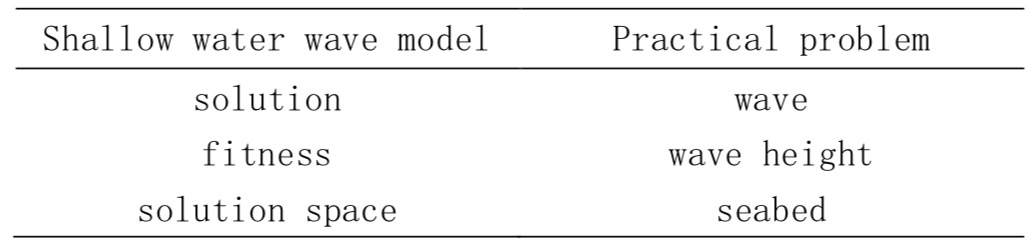
Water Wave Optimization (WWO) is a novel meta-heuristic algorithm based on shallow water wave theory. The algorithm compares each solution in the population to a water wave with wavelength λ and wave height h, and efficiently searches in the solution space by simulating the propagation, refraction and breaking motion mechanism of water waves. The algorithm compares the optimization problem to be solved with the shallow water wave model, as shown in Table 1.

Table 1 Correspondence between shallow water wave model and actual problem
The core of the water wave optimization algorithm is to assign each solution a wavelength that is inversely proportional to its fitness, and make each solution propagation (search) range proportional to its wavelength: the closer to the sea level, the better the corresponding solution, the corresponding The higher the water wave, the larger the wave height of the water wave and the smaller the wavelength, as shown in Figure 1 . During each iteration, the propagation operation causes each wave x to move each dimension d within a range proportional to its wavelength λx to create a new wave x', as shown in the following equation.

The function rand is used to generate a random number in the specified range, and L(d) is the length of the solution space in the `d` dimension.
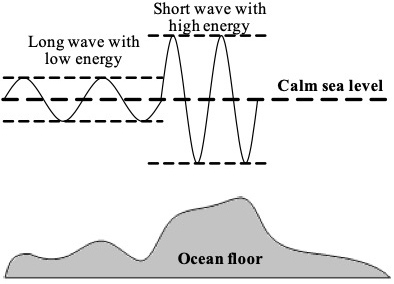
Fig.1 Relationship between fitness, wavelength and wave height of solutions in WWO

WWO also provides two operations, reflection and breaking. When a solution has not been improved after a specified iteration, its energy is exhausted and the wave height will be zero, then the reflection operation is replaced by a random solution between it and the current optimal solution to avoid the algorithm search stalling. . Whenever a new current optimal solution is found, applying the shattering operation splits it into several isolated waves, each wave moving a new distance from the new optimal wave in a random direction, thereby enhancing the local search for. Through the above operations, the WWO algorithm can achieve a good dynamic balance between global search and local search.

Relevant research

Since the WWO algorithm was proposed, it has attracted a lot of attention because of its simple framework, easy implementation, fewer control parameters, and superior performance. The current research is mainly in two aspects: one aspect is to improve the algorithm and population learning mechanism in the algorithm to improve the performance and convergence of the algorithm by changing its own operators [2-5] or combining WWO with other heuristics and meta heuristics [6-11]. Currently, the WWO algorithm and its variants have been applied to many industrial problems [12-23]. Another aspect of research is primarily to adapt WWO to a specific combinatorial optimization problem (COP). A class of COP can be expressed as an integer programming (IP) problem [24-28], and another variant of the algorithm proposes the use of a single wave rather than a wave group [29,30].

Recent progress

Professor Zheng, in 2019, published his paper Water Wave Optimization for Combination Optimization: Design Strategies and Applications [31] in Applied Soft Computing Journal. This paper proposes a systematic approach that consists of a set of basic steps and strategies for adapting water wave optimization (WWO), a simple and generic metaheuristic, to concrete heuristic algorithms for different COPs. Taking advantages of the generic algorithmic framework, designers can only focus on adapting the prorogation operator and the wavelength calculation method according to the combinatorial properties of the given problem, and thus easily derive efficient problem-solving algorithms.

References

[1] Zheng, Yu-Jun. Water wave optimization: A new nature-inspired metaheuristic[J]. Computers & Operations Research, 2015, 55:1-11.

[2] Zhang B, Zhang M X, Zhang J F, et al. A water wave optimization algorithm with variable population size and comprehensive learning[C]//International Conference on Intelligent Computing. Springer, Cham, 2015: 124-136.

[3] Liang J J, Qu B Y, Suganthan P N, et al. Problem definitions and evaluation criteria for the CEC 2015 competition on learning-based real-parameter single objective optimization[J]. Technical Report201411A, Computational Intelligence Laboratory, Zhengzhou University, Zhengzhou China and Technical Report, Nanyang Technological University, Singapore, 2014.

[4] Wu X, Zhou Y, Lu Y. Elite opposition-based water wave optimization algorithm for global optimization[J]. Mathematical Problems in Engineering, 2017, 2017.

[5] Zhang J, Zhou Y, Luo Q. An improved sine cosine water wave optimization algorithm for global optimization[J]. Journal of Intelligent & Fuzzy Systems, 2018, 34(4): 2129-2141.

[6] Hematabadi A A, Foroud A A. Optimizing the multi-objective bidding strategy using min–max technique and modified water wave optimization method[J]. Neural Computing and Applications, 2018: 1-19.

[7] Rong Z Y, Zhang M X, Du Y C, et al. A Hybrid Evolutionary Algorithm for Combined Road-Rail Emergency Transportation Planning[C]//International Conference on Swarm Intelligence. Springer, Cham, 2018: 465-476.

[8] Zheng Y J, Wang Y, Ling H F, et al. Integrated civilian–military pre-positioning of emergency supplies: A multiobjective optimization approach[J]. Applied Soft Computing, 2017, 58: 732-741.

[9] Lenin K, Ravindhranath Reddy B, Suryakalavathi M. Hybridization of firefly and water wave algorithm for solving reactive power problem[C]//International journal of engineering research in Africa. Trans Tech Publications, 2016, 21: 165-171.

[10] Singh G, Rattan M, Gill S S, et al. Hybridization of water wave optimization and sequential quadratic programming for cognitive radio system[J]. Soft Computing, 2018: 1-21.

[11] Zhang J, Zhou Y, Luo Q. Nature-inspired approach: a wind-driven water wave optimization algorithm[J]. Applied Intelligence, 2019, 49(1): 233-252.

[12] Zhou X H, Xu Z G, Zhang M X, et al. Water wave optimization for artificial neural network parameter and structure optimization[C]//International Conference on Bio-Inspired Computing: Theories and Applications. Springer, Singapore, 2018: 343-354.

[13] Liu A, Li P, Sun W, et al. Prediction of mechanical properties of micro-alloyed steels via neural networks learned by water wave optimization[J]. Neural Computing and Applications, 2019: 1-16.

[14] Kilany M, Hassanien A E, Badr A. Accelerometer-based human activity classification using water wave optimization approach[C]//2015 11th International Computer Engineering Conference (ICENCO). IEEE, 2015: 175-180.

[15] Xu W, Ye Z, Hou Y. A fast image match method based on water wave optimization and gray relational analysis[C]//2017 9th IEEE International Conference on Intelligent Data Acquisition and Advanced Computing Systems: Technology and Applications (IDAACS). IEEE, 2017, 2: 771-776.

[16] Chen H, Hou Y, Luo Q, et al. Text feature selection based on water wave optimization algorithm[C]//2018 Tenth International Conference on Advanced Computational Intelligence (ICACI). IEEE, 2018: 546-551.

[17] Ren Z, Wang C, Fan X, et al. Fuzzy clustering based on water wave optimization[C]//2018 13th International Conference on Computer Science & Education (ICCSE). IEEE, 2018:1-5.

[18] Siva M, Balamurugan R, Lakshminarasimman L. Water wave optimization algorithm for solving economic dispatch problems with generator constraints[J]. International Journal of Intelligent Engineering and Systems, 2016, 9(4): 31-40.

[19] Zhou Y, Zhang J, Yang X, et al. Optimal reactive power dispatch using water wave optimization algorithm[J]. Operational Research, 2018: 1-17.

[20] Zhao S, Li Z, Yun X, et al. IIR filters designing by water wave optimization[C]//2017 13th IEEE International Conference on Control & Automation (ICCA). IEEE, 2017: 347-352.

[21] Fard A M F, Hajaghaei-Keshteli M. A tri-level location-allocation model for forward/reverse supply chain[J]. Applied Soft Computing, 2018, 62: 328-346.

[22] Fard A M F, Hajiaghaei-Keshteli M. A bi-objective partial interdiction problem considering different defensive systems with capacity expansion of facilities under imminent attacks[J]. Applied Soft Computing, 2018, 68: 343-359.

[23] Song Q, Zheng Y J, Huang Y J, et al. Emergency drug procurement planning based on big-data driven morbidity prediction[J]. IEEE Transactions on Industrial Informatics, 2018.

[24] Zheng Y J, Zhang B, Xue J Y. Selection of key software components for formal development using water wave optimization[J]. Journal of Software, 2016, 27(4): 933-942.

[25] Wu X B, Liao J, Wang Z C. Water wave optimization for the traveling salesman problem[C]//International Conference on Intelligent Computing. Springer, Cham, 2015: 137-146.

[26] Yun X, Feng X, Lyu X, et al. A novel water wave optimization based memetic algorithm for flow-shop scheduling[C]//2016 IEEE Congress on Evolutionary Computation (CEC). IEEE, 2016: 1971-1976.

[27] Zhao F, Liu H, Zhang Y, et al. A discrete water wave optimization algorithm for no-wait flow shop scheduling problem[J]. Expert Systems with Applications, 2018, 91: 347-363.

[28] Zhao F, Zhang L, Liu H, et al. An improved water wave optimization algorithm with the single wave mechanism for the no-wait flow-shop scheduling problem[J]. Engineering Optimization, 2018: 1-16.

[29] Shao Z, Pi D, Shao W. A novel discrete water wave optimization algorithm for blocking flow-shop scheduling problem with sequence-dependent setup times[J]. Swarm and Evolutionary Computation, 2018, 40: 53-75.

[30] Shao Z, Pi D, Shao W. A novel multi-objective discrete water wave optimization for solving multi-objective blocking flow-shop scheduling problem[J]. Knowledge-Based Systems, 2019, 165: 110-131.

[31] Zheng Y J, Lu X Q, Du Y C, et al. Water wave optimization for combinatorial optimization: Design strategies and applications[J]. Applied Soft Computing, 2019: 105611.